
The Triggering Town and Comics
How Richard Hugo's book on poetry can inspire comic experimentation. And, Amaris has some big news!


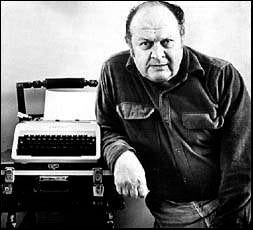
Amaris and Nora (the proverbial “us/we” of Autobiographix) love interdisciplinary pursuits; in fact, we met many moons ago when Nora taught some classes as an adjunct in the interdisciplinary-focused Honors College at the University of New Mexico, where Amaris is an Associate Professor. We ended up teaching a class together, “Sketching Autobiographix and Poetry Comics” (Substack origin story!). In that class, with both of us coming from the creative writing world, (MFAs in Creative Nonfiction and Poetry) we used a slim book on poetic craft and inspiration from poet Richard Hugo. The book, The Triggering Town, collects essays and lectures from Hugo. We’ve always felt Hugo’s insights aligned nicely with creating comics, especially poetry comics (which we’ve written about here and here, in the form of poetry comic exercises; look for a more thorough write-up on the background of poetry comics this summer!).
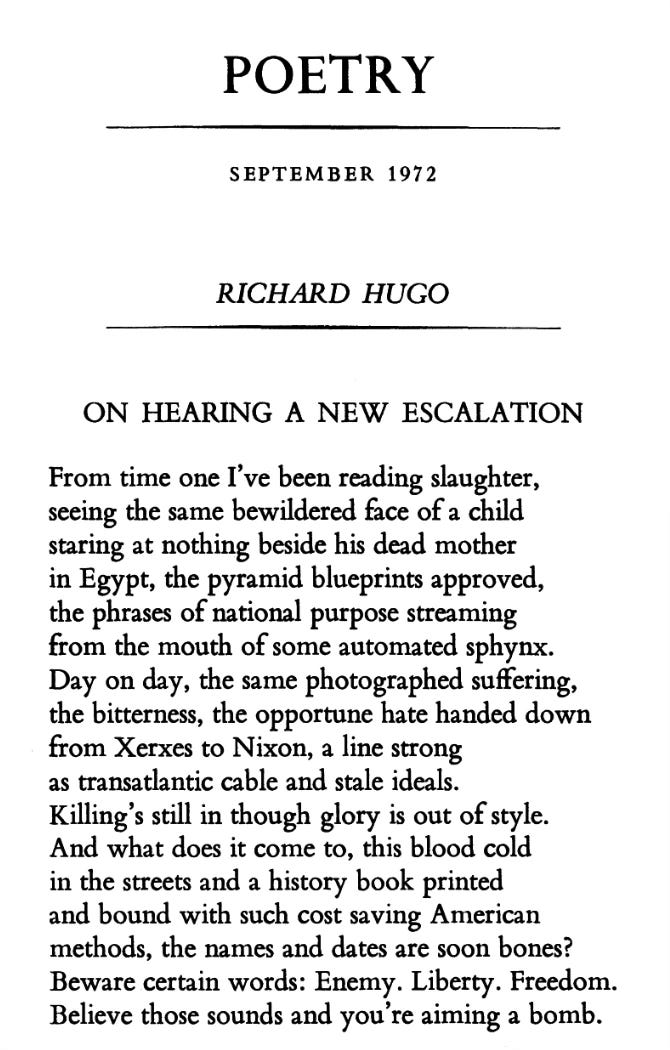
We thought re-visiting Hugo for an almost-summer post could inspire ourselves, and maybe you, to try a few poem-oriented exercises in our comics.
Before we share some of Hugo’s ideas for making/creating, here’s a few (very distilled) takeaways from The Triggering Town:
Hugo is a big believer in learning by doing: “I’ve come to believe that one learns to write only by writing…reading is important if it excites the imagination, but what excites the imagination may be found in any number of experiences (or in a lack of them). Reading may or may not be one.”
On triggering towns/subjects: “A poem can be said to have two subjects, the initiating or triggering subject, which starts the poem or ‘causes’ the poem to be written, and the real or generated subject, which the poem comes to say or mean, and which is generated or discovered in the poem during the writing.”
Think small: “Often, if the triggering subject is big (love, death, faith) rather than localized and finite, the mind tends to shrink. Think small.”
Exercises
These are meant to be used for play and experimentation, a way into your own comic voice: “…I hope you learn how to write like you,” as Hugo says in his first chapter.
In a comic of at least three panels, ”Make the subject of the next sentence different from the subject of the sentence you just put down.” You could do this subject changing with the words only, the images, or both.
Make two short comics of the same subject—but, in one use multisyllabic words, and the other use single syllable words. You could keep the images the same, or change them according to the conveyance of the words. Hugo purports that “…in English multisyllabic words have a a way of softening the impact of language. With multisyllabic words, we can show compassion, tenderness, and tranquility. With single-syllable words we can show rigidity, honesty, toughness, relentlessness, the world of harm unvarnished” (Yikes vs. bewilderment!?…do comics use more single syllable words than other forms of writing, we wonder? An exploration for another post…).
Experiment with conveying emotion without explaining the source of the emotion. In a comic, you have the aid of color, shading, expression, shadows, emanata, etc. to help with this: in your comic, “take someone you emotionally trust, a friend or a lover, to a town you like the looks of but know little about, and show your companion around the town in a poem [or comic]…imagine that an hour before the poem begins you received some very good news or come very bad. But do not mention this news in the poem.”
Create a vocabulary—written and visual—that is chock full of words you love and carry, perhaps from a place you are from or a vocation you fill. Hugo says, “Your obsessions lead you to your vocabulary. Use any noun that is yours, even if it only has local use. ‘Salal’ is the name of a bush that grows wild in the Pacific Northwest. It is often not found in dictionaries, but I’ve known that word long as I can remember. I had to check with the University of Washington Botany Department on the spelling when I first used it in a poem. Is it a word, and it is my word. That’s arrogant, isn’t it? But necessary. Don’t be afraid to take emotional possession of words.”
This one is straightforward enough: “Don’t erase. Cross out rapidly and violently, never with slow consideration if you can help it.” We thought it would be interesting to see in a comic—what would showing crossed out images/words evoke in comic form?
Other news:
In a very exciting update, Amaris is going to Scotland next semester, on a Fulbright!
Here’s her announcement:
I’m absolutely thrilled to share that I’ve been selected for a Fulbright to Scotland! 🏴 🏴🏴🏴🏴
Next year, I’ll be a Fulbright Distinguished Scholar at the University of Edinburgh, based in the Institute for Advanced Studies in the Humanities.
My project will explore Scotland’s blue and green spaces through graphic medicine (creative nonfiction comics) and archival research—from historic seaside cures to contemporary wild swimming and nature-based wellbeing.
I can’t wait to connect with wild swimming communities, artists, writers, storytellers, and other folks who love Scotland’s coasts, neighborhoods, and green spaces. 🌊🌲🏴
What fabulous news! They will be lucky to have you, Amaris. Congratulations.
Great prompts! Very cool translation of Hugo-- plus that stellar, timely poem. And big congrats, Amaris!! Scotland, Ho!