
An Interview with Mohammad Sabaaneh
Art is an arena of struggle, just like other arenas of struggle where Palestinians fight. It is important to read our artistic narratives as a testimony from the occupied land, not as entertainment.


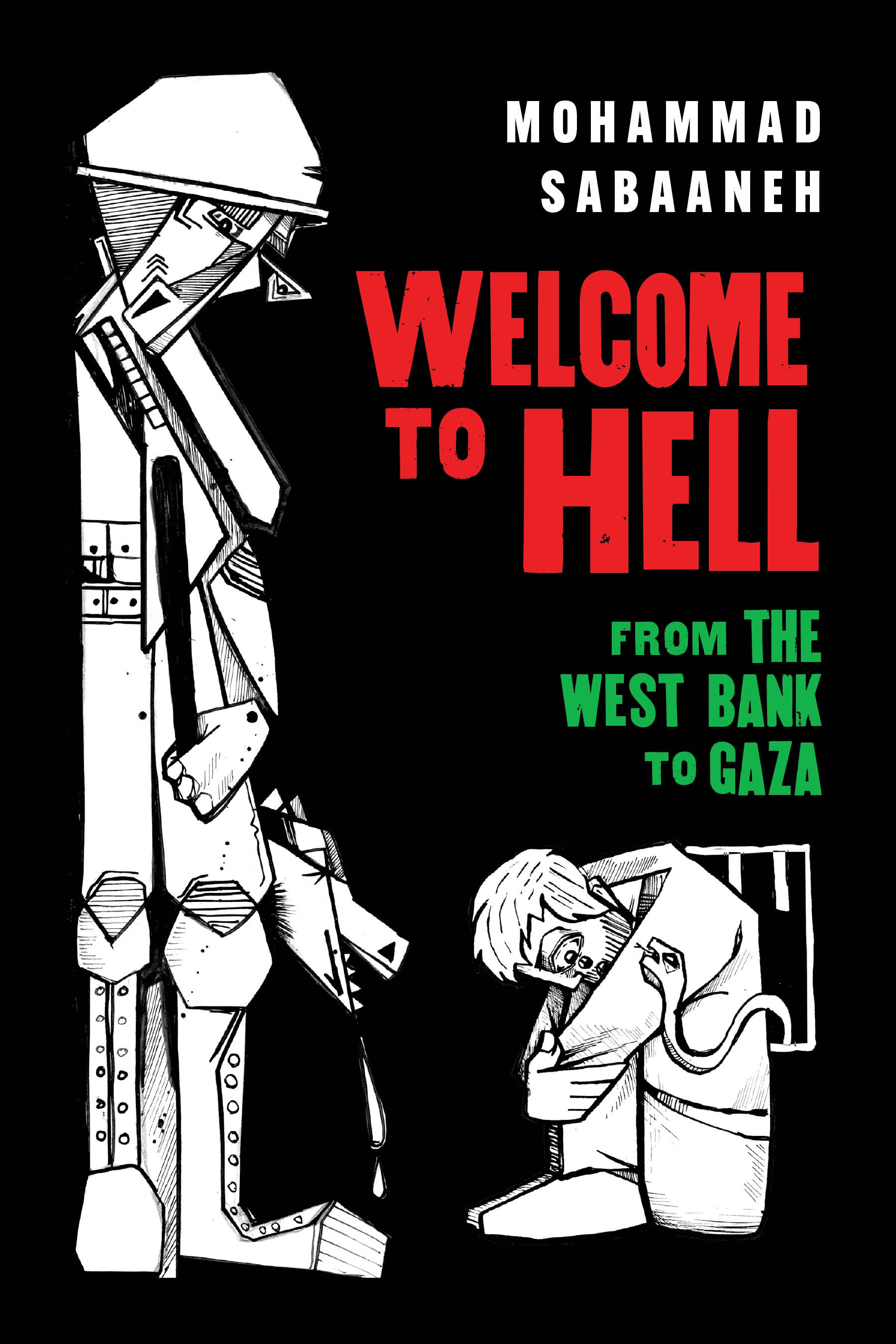
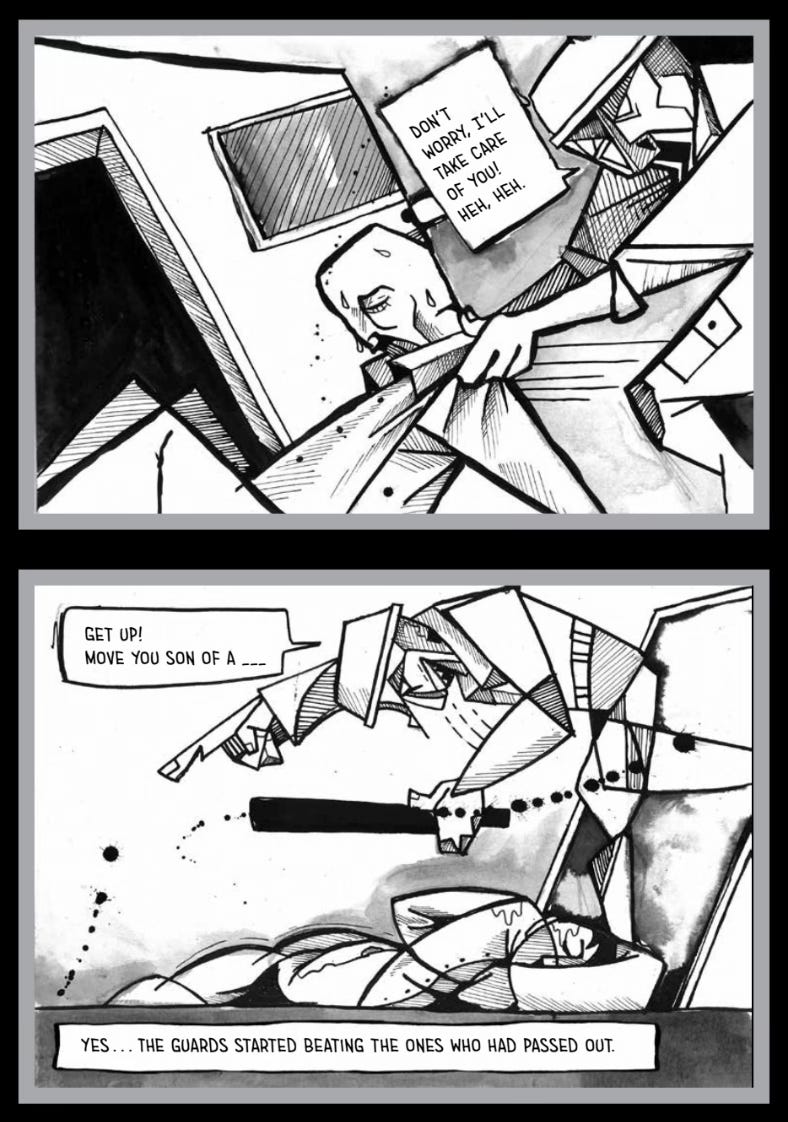
Mohammad Sabaaneh is a Palestinian cartoonist, whose latest work, Welcome to Hell: From the West Bank to Gaza, achingly reveals the various imprisonments Palestinians endure. We learn early on that, “this graphic novel exposes one of the most harrowing extensions of this system: the machinery of repression within Israeli prisons, where Palestinian prisoners endure systemic violence, isolation, and dehumanization.” The bulk of the work takes place in an Israeli prison where Sabaaneh’s brother, Thamer, was detained (and brutalized). Sabaaneh’s art is expressive, with faces strikingly inked out in black lines, splotches of ink raining on particularly harrowing scenes, and modulated grays washing over it all. In Sabaaneh’s eloquent images, the Israeli prison guards harbor angular lines, which evoke Cubism. In a recent interview with The Comic Book Yeti, Sabaaneh explains this choice, sharing, “…we are surrounded by Cubism, we are surrounded by geometric shapes and geometric forms created by the occupation. And those forces repress everything real and everything organic Palestinian.” That repression is an enduring message of the book. And, an extremely important missive from a place that is both constantly on the news, and is not—that is, for Western (and other) readers, it is far too easy to turn off the news report, set down our phones, and tune out. Sabaaneh’s graphic novel shows just how impossible that turning away is for himself, his family, and Palestinians in general. Sabaaneh’s visual revelations underscore the point that as difficult as the book can be for readers, it is necessary to keep reading.
Please read on for Sabaaneh’s insight into his comic making, his books, and being a Palestinian comic artist, as well as what he wishes for readers of Palestinian works.
Describe your comics journey—how did you get into making comics?
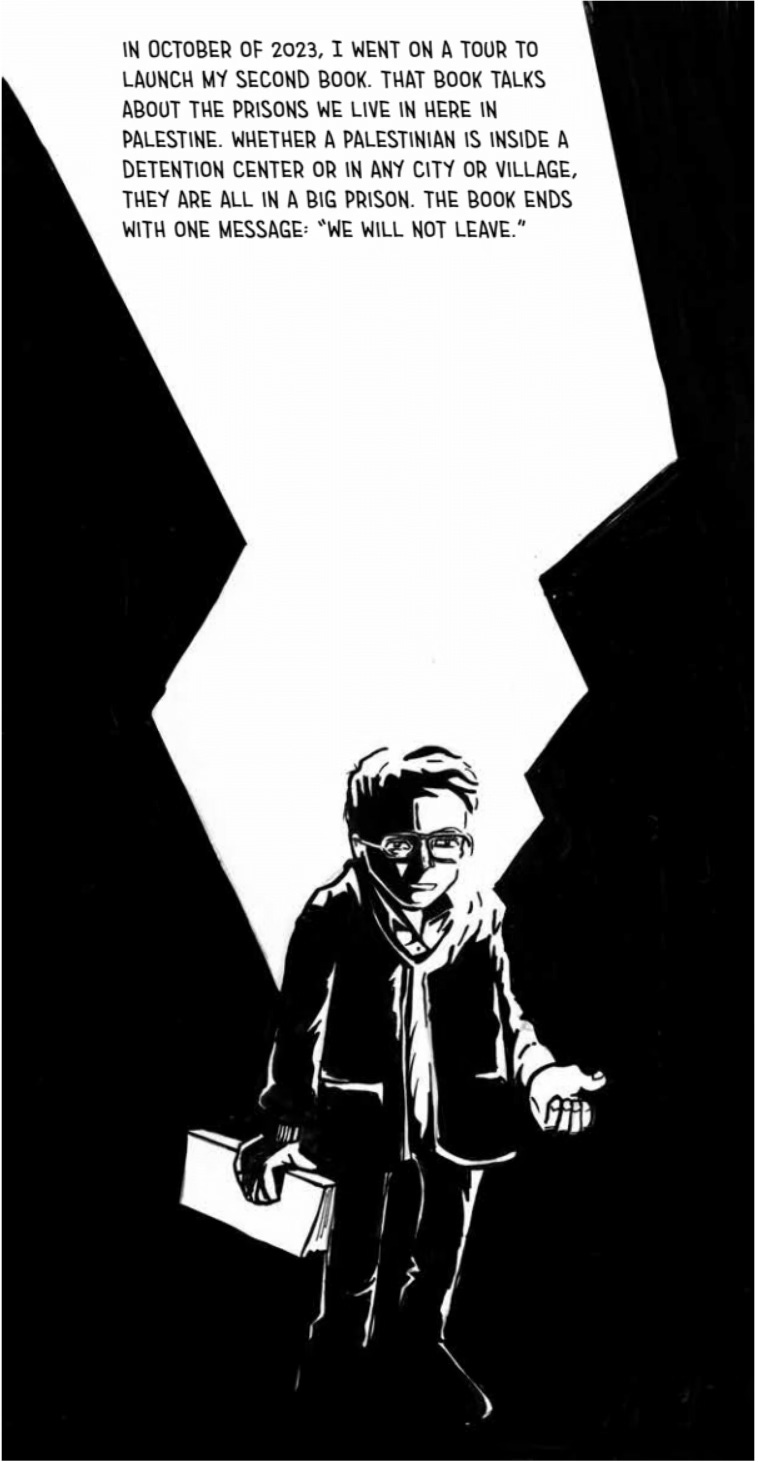
As a cartoonist, I do a lot of daily cartoons for daily newspapers to convey the lives of Palestinians, and the suffering of people in general. After my imprisonment in 2014, my work has meant that I have traveled to many countries, and I’ve seen the experiences of other comic artists. And I realized, that as a cartoonist, I had been focusing a lot on the idea, but not on the art itself, the artistic side of my work. So, I decided to make my first book. It was an artistic experiment to develop my use of visual language in cartoons. The journeys I have taken to present my new book, introduced me more to the art of comics and its different uses, and I met many artists like Seth Tobocman, Ethan Heitner, and other artists who encouraged me to do comics. But honestly, the person who encouraged me the most was Liz, publisher of Street Noise Books. She visited me in Ramallah years ago and asked me to do a graphic novel with her. At the time, I was preparing for my master’s degree, so I turned her down. I told her I would be traveling and studying for my masters. But when I traveled to Britain, I thought about doing my master’s thesis as a comic book. And that was the first comic book I created, and Liz published it at Street Noise.
Welcome to Hell begins from an intensely immediate historical moment. What did you most want to preserve on the page about this period that you feared might otherwise be forgotten or misunderstood?
Since I returned to Palestine in 1998, I can’t remember a period of time that wasn’t crucial or critical in the lives of Palestinians. After I arrived, it started with the presence of the Palestinian Authority, then the second Intifada, then what happened after the second Intifada and the blockade of Palestinian cities, then the uprising of knives, the wars on Gaza, and finally the recent genocide. Therefore, in Palestine, there are always difficult times we go through as Palestinians on this land. What I want to convey in not just this book, but all my artistic productions, is that we as Palestinians are responding to the Israeli narrative that we are human animals, that we are backward and primitive people. Their famous saying “a land without a people for a people without a land,” deliberately denies that this land had a people on it, my people, before the establishment of the State of Israel. What’s important in this historical moment is how Israel has revealed its ugly face to the whole world. Today the European public, as well as many Americans believe that Israel is a criminal state, a state that violates human rights, and does not recognize the rights of Palestinians, and does not recognize international law. Israel’s ugly face has been revealed to the world, and I, as a Palestinian cartoonist, must continue my work to document these Israeli violations against Palestinians, against our prisoners, against our children, against our women, against everyone. Therefore, all the artistic projects I do, whether my first book, second book, or third book, is a response. And as Edward Said wrote, “nations themselves are narrations.” Therefore, we as Palestinians must keep our narrative present in people’s minds, challenging the Israeli narrative, and challenging the narrative of this colonial settlement.
When the world is full of competing narratives and propaganda, what can comics do that journalism or prose alone cannot?
Comics is a very important form of discourse, especially in this world full of artificial intelligence and new tools being used to invent discourse. We as Palestinians must be present in this form of discourse and in this visual language. For many years, we were absent or obscured from the world of comics. The art of comics began with my first book released by Street Noise, Power Born of Dreams, which can be considered the first Palestinian graphic novel to come from within Palestine. The art of comics is, as I said, very important, in a world full of artificial intelligence and digital products. Our presence as Palestinians is very important, especially since there are many narratives justifying the Israeli occupation of Palestinians and the occupation of Palestinian land. These narratives are taken from one side, and promoted through the use of certain historical events and historical tragedies to justify the establishment of a state on Palestinian land. There is a worldwide audience interested in comics, so it is important that we, as Palestinians, use the art of comics to refute the narratives of the Israeli government. We use this art form to prove that the Palestinian people is a living people, with arts, literature, culture, and history, and a connection to this land, contrary to the Israeli propaganda that promotes that Palestinians are human animals, uncivilized peoples, and so on. The art of comics has been used in many ways, whether to document the collective catastrophe or to convey to the world the tragedy of people and the difficult circumstances that our people go through.
Anything you want readers to know about?
Comics and cartoons in many parts of the world are seen as entertainment, fun, a way to pass the time. Many do not look at them as serious arts. But unfortunately, as Palestinians, we are always forced to use all forms of art and aspects of life even those that might be used by others as a means of enjoyment and fun, as a form of discourse and resistance. This is true whether in comics, cartoons, arts, music, or otherwise. It is very important for us as Palestinians to use these things to highlight the image of the Palestinian and preserve our identity and our own narrative against the propaganda made by the mainstream media, some websites, newspapers, and on television that seem to always try to demonize the Palestinian and portray him in wrong and inaccurate ways. We as Palestinians remain on this land, a people with art, literature, and all forms of culture. As you may know, we developed so much academically in the world, theories, inventions, and so on. Art is an arena of struggle, just like other arenas of struggle where Palestinians fight. It is important to read our artistic narratives as a testimony from the occupied land, not as entertainment. It is important for people to see that what we have done or what we are doing in producing these comics is not abstract or removed from the writer; the writer or artist who produces creative work in Palestine lives this tragedy every day, conveying it through his feelings and his ability of visual depiction. It is not invented or imagined; it is reality lived by people on the occupied land.
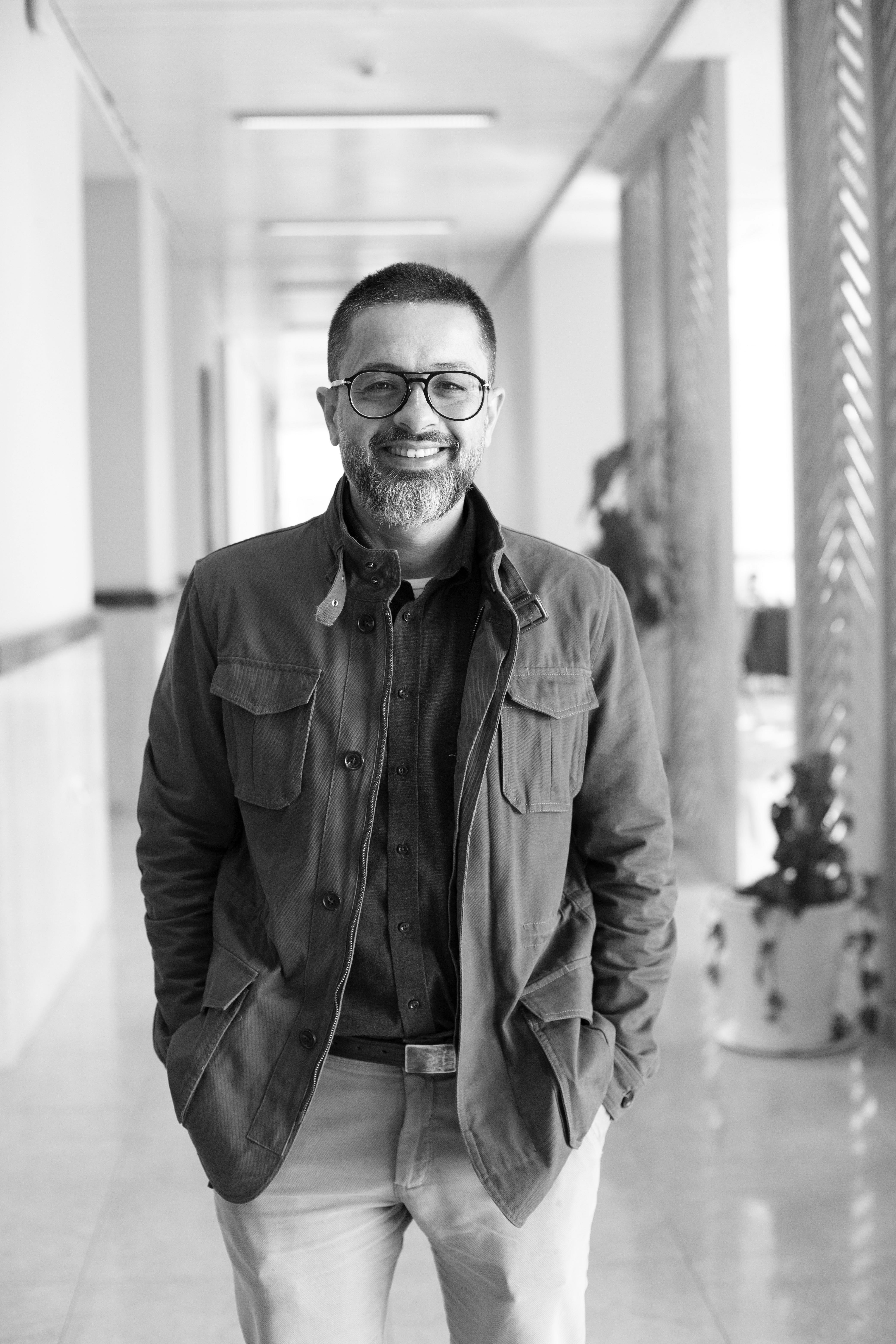
Mohammad Sabaaneh is the principal cartoonist for the Palestinian Authority's daily newspaper, Al-Hayat al-Jadida. He is a Middle East representative for the Cartoonists Rights Network International and teaches art at the Arab-American University of Palestine. Mohammad currently lives in Ramallah, in the West Bank.